Digital menu boards for restaurants
The plain guide: what to buy and what to ask.

There are four main kinds of menu boards. Here is what each does well, what it asks of you each week, and how to pick.
A menu board is any board that shows what you sell and what it costs. People use the words for four very different things: a printed sign, a chalk or letter board, a light box, and a screen. Each one can look great. Each one asks something different of you every week.
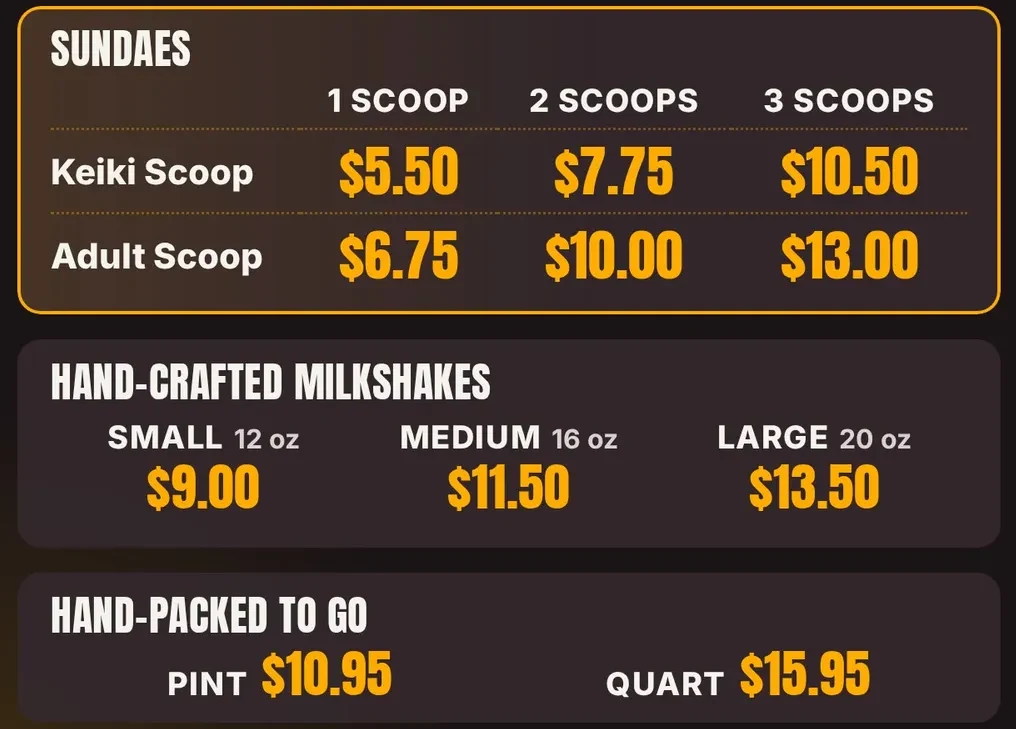
We run Sweet Aloha Ice Cream in Davie, Florida. Today all 5 of our TVs play a Wow Menu Boards menu every day, so we know what a screen costs in time, not only in money. For paper and chalk, the points below are plain facts about how those boards work. Below, each kind gets one short part: what it is good at and what to watch for.
A printed board is a poster or a sheet in a frame. It is the lowest-cost way to start, and a good print looks sharp and calm. It never needs power or Wi-Fi, and nothing on it can freeze.
The catch comes on the day a price changes. You send the file to a print shop, wait, pick it up, and hang it. Until then the old price hangs on the wall. Say you have 12 prices and 4 of them change in spring. That is a whole reprint for four numbers. Many shops cover the old number with a sticker, and after three stickers the board looks tired. Printed boards fit a menu that almost never changes, like a short list of coffee drinks.
A chalk board feels warm. It says “a person made this today.” Customers like that, and it costs next to nothing to start. You can change a price in a minute with a cloth and a pen.
The work moves to your team. Someone with neat handwriting has to write every line, every time, and keep it straight. Letter boards with plastic letters are neater, but you need the right number of every letter, and a long flavor name can run out of room. Chalk fits a small, friendly menu of five or six items, written by one steady hand. It is a harder fit once your list grows past one board.
A light box is a backlit panel, often with printed film slid into a frame. It glows, so it reads well in a dim room and from far away. The picture is bright, and it looks clean.
It still has the printing problem. To change one price, you print a new film and slide it in. The box also takes up wall space and needs an outlet, and you need to replace the bulbs or strips someday. A light box is a good choice when your menu is steady and you want a bright, fixed look. If you change items each season, the reprint work adds up fast.
A digital menu board is a TV on the wall that shows your menu as pictures and short videos. A change is a message, not a print job. The screen can show a different board for each part of the day, and it can go dark after hours.
Here is what runs in our own shop today: full-HD motion video, an exact on and off schedule, the menu keeps playing if the internet drops, and the app updates itself. The tradeoff is real. You need a TV, a player (many Fire TVs have one built in), and a plan. Our Basic plan is $12 per screen, per month, and our team handles setup and changes. For the full list of costs, read digital menu board cost.
Skip the long lists. Three questions pick the kind for most shops.
If two answers point to a screen, try one. Our guide for restaurants shows what to ask before you buy.
Want to see a screen in your shop? We set up your first one with you. Try it free for 14 days, no card.
You do not have to pick only one. Many shops keep a chalk board by the door for the daily special and use a screen for the main menu. Others keep one printed sign for the rules, like allergy notes, and a screen for prices that change.
A good mix is simple: put the part that never changes on paper, the part that changes sometimes on a screen, and the part with a personal touch on chalk. At our shop the screens carry the menu and the seasonal boards. A person still hands you the scoop. Ready to try a screen? Start with how to turn a TV into a menu board.
The plain guide: what to buy and what to ask.
What small shops really pay, in plain parts.
Five steps, with examples from our shop.
Three kinds of electronic menu, and which fits a line.
We open free trials a few shops at a time, and we set up your first screen with you.
14 days free, no cardNo contract. Cancel anytime.